Showing posts with label Initial Work. Show all posts
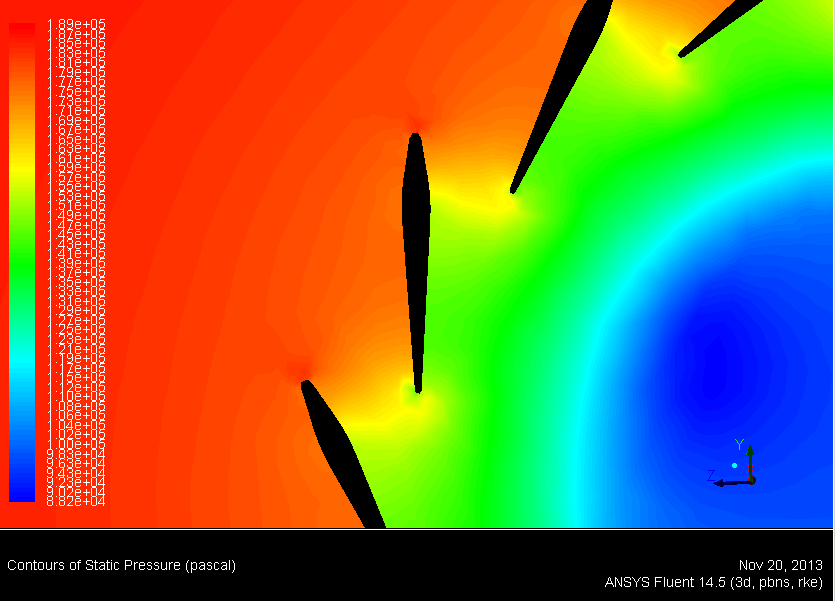
We are setting the benchmark for our own concept designs by running CFD on the original Holset design. This first attempt was run at low load, with the nozzle in the 100% open position.

Ricardo Wave software will be used to find the parameters required for more detailed studies at multiple load conditions.


As promised we have uploaded the full video of one laser scan process using the FaroArm and GeoMagic software. Please excuse me turning the camera around after 20 seconds or so!

Initial passover of the inside face of the turbine housing

View here or click play on the embedded player below:
http://www.youtube.com/watch?v=W9wtq5b65QI&feature=youtu.be
Please subscribe to our channel!

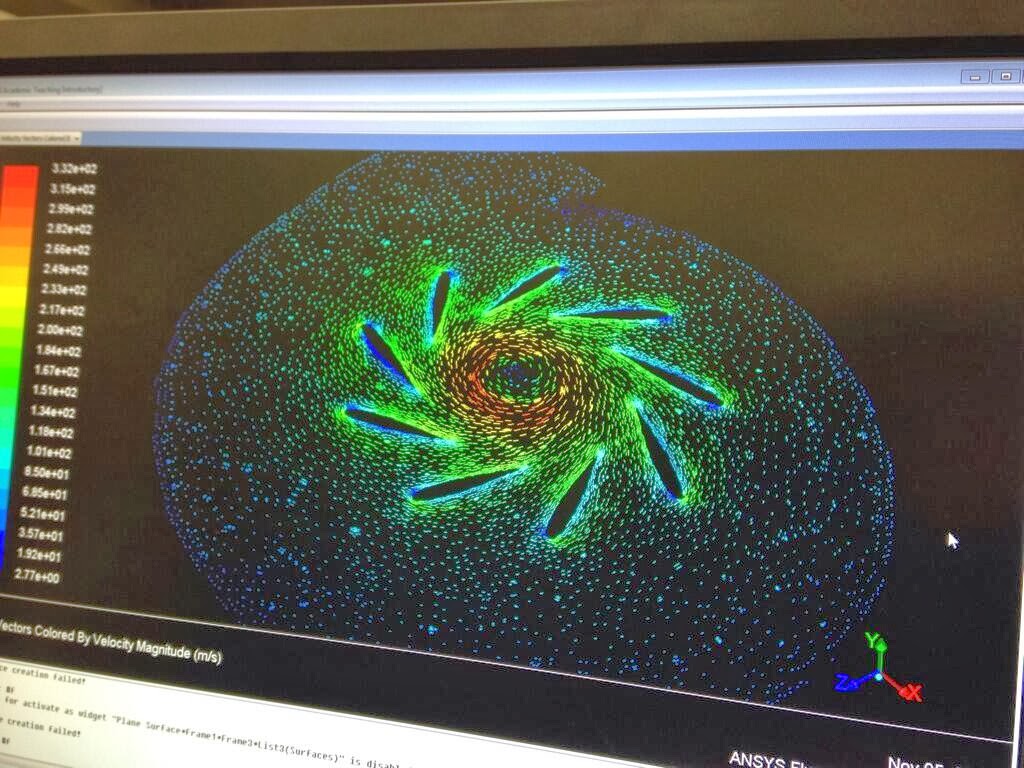
As part of the build up to producing our own component designs, the process has begun of building a numerical model within ANSYS FLUENT for solving. Using borrowed CAD files of a similar turbocharger, I experimented with boundary conditions and solver settings; although the mesh used was very coarse.

Solver: K-Epsilon with SST (Shear Stress Transport Equation)
Mesh Size: Approx 200,000
Inlet Velocity: 70m/s
Inlet Temp: 1030K

Basic Solution with coarse mesh: Velocity Vectors through a plane

The central area was left free here (ie. No Rotor defined) for simplicity, I plan to work on a number of different models and decide on the best for analysing our designs.

Todays work involved the scanning of some 3D components using a FaroArm (See here: Faro.com). This equipment uses laser technology to determine a 3D profile and produce a 'mesh' of the part. The file opens in a software called GeoMagic which can be used to edit the data points and reduce the file size before exporting into more common CAD formats.

FaroArm and Components to be Modelled

A FaroArm is essentially a portable CMM (Coordinate Measuring Machine) that can use either a ball probe or a laser probe for mapping 3D parts. With the help of a Keith, a Brunel Technician, we set to work scanning the outside of the turbine house shown below and the turbine wheel.

1 Side of the Turbine Housing Scan in GeoMagic

GeoMagic automatically relays the data onto the screen and then produces a mesh as shown above. Initially our scan contained around 3 million nodes (data points) but following a series of reductions using the "decimate" tool the final file contained 300,000 nodes and was approximately 100MB. The file produced is in a .stl format which can then be opened in Solidworks for modelling purposes.

The turbine housing was successfully completed, however the turbine will be scanned after arm calibration in a weeks time. A video will follow shortly!


The first major step forward in our project occurred with the delivery of our Turbocharger. The model in question is a Holset HY40-V with a sliding vane mechanism. The guys were very keen to get this taken apart, and we were quick to grab a copy of the manual and technical drawings so we could start work...

A collection of the dismantled turbocharger parts following an hours work. 

Thanks to Vijay, our resident techno-wiz, we also have a time-lapse-style video of some of the dismantling process, which can be seen below (Or on youtube: http://www.youtube.com/watch?v=HV8WkWoLCdw):


All in all this was a rewarding hour or so to spend, we all developed a better understanding of how the product goes together, this can only help us in trying to improve its design. The next steps in the process of initial analysis are to scan significant parts using either a CMM (Co-ordinate Measuring Machine) or a FaroArm laser scanning tool.

These steps are to enable us to build an accurate CAD model by importing physical data from the scanning machines; from this point we can use the initial design as a benchmark in CFD and create our own designs to hopefully improve performance.


© 2013 Turbo Nozzle Development is designed by Templateify & Sponsored By Your Link Here